Where a generated clip goes in a teaching video, and where it can't
A stock or generated clip looks good and knows nothing. In a video that teaches, it can open the question and never give the answer. Three rules you can write as one function and run at every stage of the edit.
Also in: Español
If you make videos that teach, a stock or generated clip looks good and knows nothing. Ask a video model for the falling ball in a physics lesson and the fall is drawn by the model, not computed. It can look perfect and be wrong. In a video that teaches, that is the one error nobody forgives.
The way out is not banning the clip, it is deciding where it goes. The clip opens the question; the answer comes from a scene built on a calculation: a simulator, a whiteboard, a chart.
Three rules
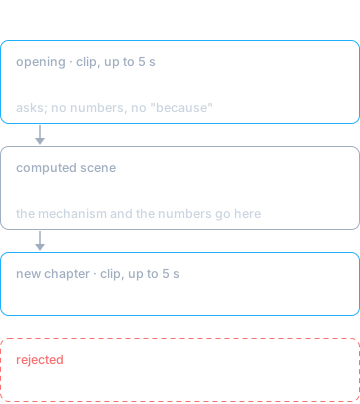
- Only at the start or between chapters. Before the first scene that explains, or at the cut where a new chapter begins. Never in the middle of an explanation.
- Up to 5 seconds. It opens and leaves.
- Its voice says no numbers and explains no mechanism. No figures, no "because", "is calculated", "depends on". A question is fine: "why does a ball fall?" asks, it does not explain.
Write it as a function
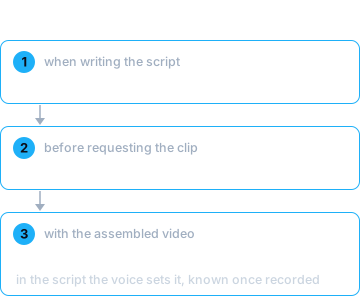
In a style guide, these rules get forgotten. As a pure function, any stage can call them:
const BROLL_MAX_S = 5;
const OPENING = new Set(['broll', 'image', 'card', 'title']);

function brollDefects(scenes) {
  const firstExplanation = scenes.findIndex((s) => !OPENING.has(s.type));
  const out = [];
  scenes.forEach((s, i) => {
    if (s.type !== 'broll') return;
    const atOpening = firstExplanation === -1 || i < firstExplanation;
    const betweenChapters = s.chapter || scenes[i + 1]?.chapter;
    if (!atOpening && !betweenChapters) out.push('broll-in-explanation');
    if (s.duration > BROLL_MAX_S) out.push('broll-too-long');
    if (numberIn(s.narration)) out.push('broll-with-number');
    if (mechanismIn(s.narration)) out.push('broll-with-mechanism');
  });
  return out;
}
numberIn catches digits and spelled-out numbers ("two", "half", "percent").
mechanismIn only looks at sentences that are not questions.
The same judge runs when the script is written, before requesting the generated clip (so you don't pay for one you throw away), and on the assembled video. That third pass exists because of duration: in the script it is set by the voice over the clip, and it is only known once recorded.
A case: the opening of a house
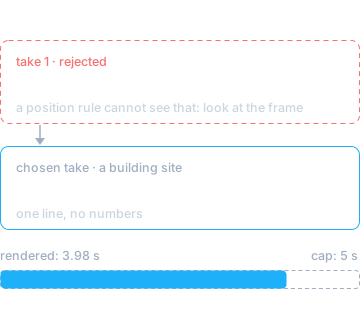
In a video about building a house in a 3D configurator, the opening is a stock clip of a building site and one line: "A real house starts on a building site." It lasted 3.98 s and the critic approved it with no defects. If the same opening says "two meters seventy because…", the edit rejects it.
The rule cannot see whether the clip shows what it says: the first take for "a house under construction" was a monument, and the image review rejected it. Detecting "mechanism" with a word list is conservative on purpose: a clip that explains without saying "because" gets through.
What has to be true is computed by the simulator; what only has to look good opens and stays quiet.
Have a case where you want to see this working? Tell us what your business does and we'll build it on your material: write to us.