One carousel, five channels: what changes on each network
The same approved carousel bounces for a different reason on Instagram, Facebook, Telegram, email and WhatsApp. The limits that matter, why they should be copied from the publisher with a test watching the copy, and why nothing gets trimmed silently.
Also in: Español
You have an approved carousel and you want it on Instagram, Facebook, Telegram, an email and a WhatsApp status. It is the same piece, but each channel bounces it for a different reason, and the bounce rarely arrives while you are looking: it arrives when the scheduled publisher runs, in the small hours.
What changes on each channel
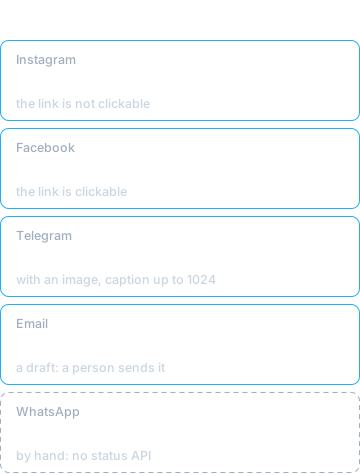
- Instagram: a carousel of 2 to 10 images and up to 2200 characters. Links are not clickable: they do nothing in the caption, so they go in the bio or a story.
- Facebook: one chosen card and the text with the link, which is clickable there.
- Telegram: two different caps. A text can reach 4096 characters, but with an image the caption cap applies: 1024. Text that fits alone does not fit with a photo.
- Email: a subject and HTML with the cards as images. It goes out as a draft; a person sends it.
- WhatsApp: no status API and no broadcast. You prepare a package (the cards and a short text) to upload by hand as a status from the phone.
Limits are not written by eye
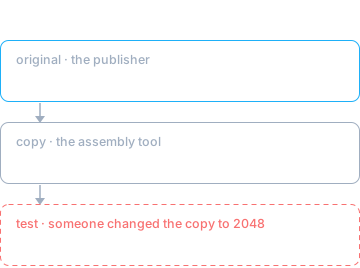
The one that decides whether a piece goes out is the publisher, which validates it before sending. If the tool where you assemble it lets through something the publisher rejects, the error shows up late and far from where it could be fixed.
Writing the caps from memory in the tool is what drifts. What works is treating that list as a copy of the publisher's and giving it a test that compares them field by field. To know the test really watches, break it: changing Telegram's caption cap from 1024 to 2048 in the copy has to turn it red:
telegram.maxCaptionLength: la copia dice 2048 y el backend 1024
If the original is not at hand, the comparison does not pass green just in case: it is skipped, and it says so.
If two systems have to agree on a limit, make one a copy of the other and have a test check it.
Nothing is trimmed silently
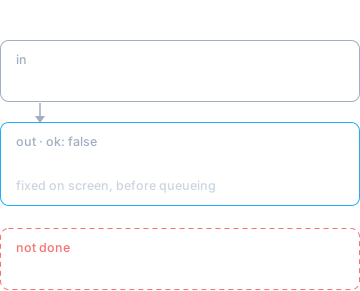
The other temptation is to trim: if the caption goes past 1024, cut it and move on. That publishes a broken sentence under your brand.
Instead, each variant comes back with ok: false and the reason written out.
A 1025-character caption for Telegram comes back untrimmed, saying it accepts
up to 1024 caption characters and the text has 1025. Eleven cards for
Instagram come back saying it accepts up to 10 images and there are 11
approved cards. The problem gets fixed on screen, before queueing, not in the
publisher's log.
Each network's rules are learned when something bounces. Write them once, in the place that decides, and let a test warn you the day the copy stops matching.
Try it on your own case: tell us what your business does and we will build it on your material.